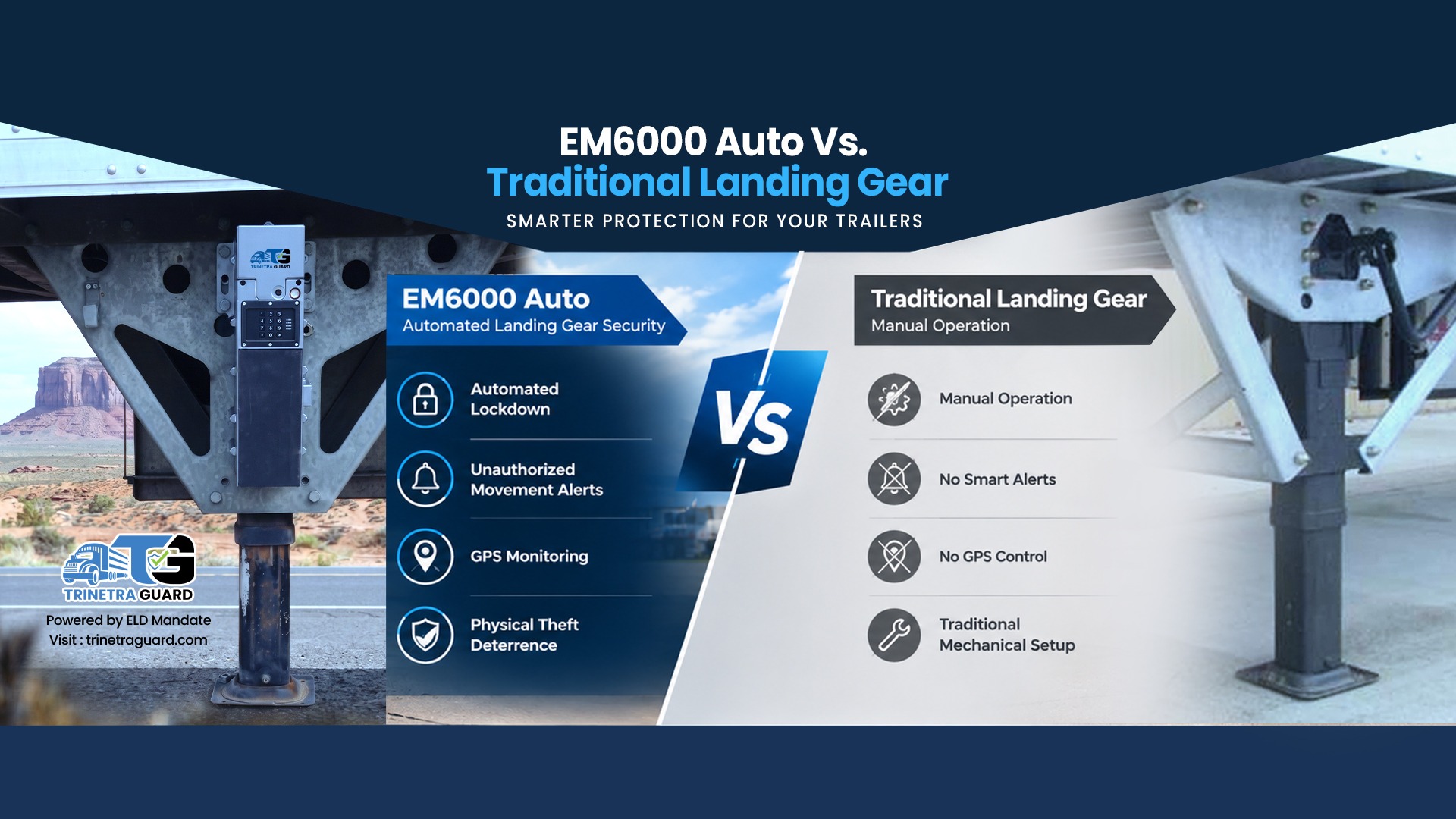
Traditional trailer landing gear has been part of trucking for decades.
Drivers pull out the crank handle, select the gear, and manually raise or lower the trailer legs. The process is familiar, but it is also physical, repetitive, and dependent on driver effort.
For years, fleets accepted manual landing gear cranking as part of the job.
But trucking operations are changing.
Fleets are investing in ELDs, GPS tracking, AI dash cams, telematics, fleet safety tools, trailer tracking, and driver-retention programs. Yet one of the most physical trailer tasks still often depends on a hand crank.
EM6000 Auto by Trinetra Guard is designed to change that.
EM6000 Auto combines trailer landing gear automation with trailer security, authorized access, GPS visibility, and fleet control. It is designed to help fleets reduce manual cranking strain, improve trailer security, support driver retention, and help prevent unauthorized trailer movement.
What Is Traditional Trailer Landing Gear?
Traditional trailer landing gear is the manual system used to support the front of a semi-trailer when it is disconnected from the tractor.
The driver uses a hand crank to raise or lower the landing gear legs.
Traditional landing gear may include:
- Manual crank handle
- Gearbox
- Low gear
- High gear
- Landing gear legs
- Cross shaft
- Support feet
- Mechanical components
The system is simple and widely used, but it requires manual effort from the driver.
What Is EM6000 Auto?
EM6000 Auto is an autonomous trailer defense and landing gear automation system by Trinetra Guard.
It is designed to help fleets automate landing gear operation while also adding trailer security and access-control features.
EM6000 Auto is designed to support:
- Automated trailer landing gear operation
- Reduced manual cranking strain
- Auto-lockdown trailer security
- Unauthorized movement prevention
- Authorized access workflows
- Back-office control
- GPS visibility
- Security alerts
- Driver-friendly trailer operations
Instead of treating landing gear as only a manual mechanical part, EM6000 Auto turns the landing gear area into part of a smarter trailer security and automation system.
Traditional Landing Gear vs. EM6000 Auto
|
Area |
Traditional Landing Gear |
EM6000 Auto by Trinetra Guard |
|
Operation |
Manual hand cranking |
Automated landing gear operation |
|
Driver effort |
Requires repeated physical effort |
Helps reduce manual cranking strain |
|
Driver experience |
Can be tiring, slow, or frustrating |
Designed to be easier and more driver-friendly |
|
Security |
Depends on separate locks or manual processes |
Supports auto-lockdown and authorized access |
|
Unauthorized movement |
Limited prevention by itself |
Designed to help prevent unauthorized trailer movement |
|
Fleet visibility |
No connected visibility by itself |
Supports GPS visibility and fleet alerts |
|
Back-office control |
Usually none |
Designed to support centralized authorization and control |
|
Consistency |
Depends on driver action and conditions |
Helps create a more consistent workflow |
|
Retention value |
Limited driver-experience benefit |
Can support driver retention and recruiting |
|
Technology level |
Mechanical only |
Automation + security + fleet visibility |
The Driver Experience Difference
Manual landing gear cranking requires the driver to physically raise or lower the trailer landing gear.
This can be more difficult when:
- The trailer is loaded
- The landing gear is stiff
- The ground is uneven
- The trailer is dropped too high or too low
- The driver is working in bad weather
- The driver is tired
- Yard space is limited
- The operation is time-sensitive
EM6000 Auto is designed to reduce that physical effort by supporting powered landing gear operation.
For drivers, this can mean:
- Less manual cranking
- Less repetitive upper-body strain
- Easier trailer handling
- More driver-friendly equipment
- A better daily experience
That driver experience matters because equipment quality is part of how drivers judge a fleet.
The Fleet Safety Difference
Traditional landing gear depends on manual effort. Over time, repetitive cranking can contribute to driver discomfort, fatigue, and physical strain.
EM6000 Auto supports fleet safety programs by helping reduce the need for repetitive cranking.
This can help safety leaders focus on:
- Reducing manual strain
- Supporting injury-prevention programs
- Improving driver ergonomics
- Modernizing equipment
- Reducing frustration around trailer handling
EM6000 Auto should not be described as eliminating all injury risk, but it can be described as helping reduce manual cranking strain and supporting driver safety initiatives.
The Trailer Security Difference
Traditional landing gear does not automatically secure a trailer from unauthorized movement.
Fleets often depend on:
- Manual locks
- Driver procedures
- Yard procedures
- GPS trackers
- Security checks
- Cameras
- Dispatch communication
These tools can help, but they may depend on human consistency.
EM6000 Auto is designed to add a more active trailer security layer.
The system can support:
- Auto-lockdown after disconnect
- Authorized access workflows
- Back-office visibility
- GPS location awareness
- Event alerts
- Unauthorized movement prevention
This is one of the biggest differences between traditional landing gear and EM6000 Auto.
Traditional landing gear supports the trailer.
EM6000 Auto is designed to support the trailer, the driver, and the fleet’s security strategy.
The Cargo Theft Prevention Difference
GPS tracking can help a fleet locate a trailer after it moves. But GPS alone does not physically stop the trailer from moving.
Traditional landing gear does not solve this problem by itself.
EM6000 Auto is designed to help fleets move from passive tracking to active prevention.
It helps answer questions like:
- Is this trailer authorized to move?
- Has the trailer disconnected?
- Is it secured after disconnect?
- Who is authorized to access it?
- Can the back office control access?
- Can the fleet receive alerts?
- Can unauthorized movement be prevented before the trailer leaves?
For fleets carrying high-value freight or managing unattended trailers, this can be a meaningful security advantage.
The Back-Office Control Difference
Traditional landing gear gives the back office very little visibility.
Dispatch may know where the trailer is, but not necessarily:
- Whether it is secured
- Whether it was accessed
- Whether the movement is authorized
- Whether a driver completed the correct manual step
- Whether the trailer needs attention
EM6000 Auto is designed to give fleet managers and dispatch teams more visibility and control.
This can support:
- Trailer movement authorization
- Security event review
- Driver support
- Drop-yard management
- Fleet operations
- Risk management
For larger fleets, leasing companies, insurers, and shippers, back-office control is a major advantage.
The Retention Difference
Driver retention is not only about pay. Equipment matters.
Drivers prefer equipment that is easier, safer, and more efficient to use.
Traditional manual landing gear can feel outdated, especially when drivers are expected to use modern ELDs, dash cams, GPS apps, and mobile tools but still manually crank trailers.
EM6000 Auto gives fleets a practical driver-experience story:
We are investing in technology that reduces manual work and makes trailer handling easier.
That message can support:
- Driver retention
- Driver recruiting
- Owner-operator satisfaction
- Safety culture
- Fleet modernization
Why Fleets Are Looking Beyond Traditional Landing Gear
The trucking industry is under pressure from multiple directions:
- Driver shortage
- Driver turnover
- Cargo theft
- Insurance pressure
- Yard security challenges
- Safety expectations
- Operational efficiency
- Equipment modernization
Traditional landing gear solves only one job: supporting the trailer when disconnected.
EM6000 Auto is designed to solve a larger set of fleet problems:
- Automating landing gear
- Reducing manual cranking
- Supporting trailer security
- Helping prevent unauthorized movement
- Improving visibility
- Supporting driver retention
- Giving fleets stronger control over trailer operations
This is why EM6000 Auto should be positioned as a new category, not merely as a motorized crank.
When Traditional Landing Gear May Be Enough
Traditional landing gear may be acceptable for fleets with:
- Very low trailer activity
- Minimal drop-and-hook operations
- Limited theft exposure
- Low driver turnover pressure
- No need for trailer-level automation
- No need for connected trailer security
But for fleets with active trailer operations, unattended trailers, high-value freight, driver-retention challenges, or security concerns, traditional landing gear may no longer be enough.
Who Should Consider EM6000 Auto?
EM6000 Auto may be especially relevant for:
- Trucking companies that own trailers
- Private fleets
- Regional carriers
- Large fleets
- Trailer leasing companies
- Drop-and-hook operations
- High-value freight carriers
- Shippers
- Distribution centers
- Fleet safety teams
- Risk-management teams
- Driver recruiting teams
- Fleets focused on cargo theft prevention
If your operation depends on trailers, drivers, yards, and security, EM6000 Auto may be worth evaluating.
Final Thoughts
Traditional landing gear has served trucking for decades, but fleet needs are changing.
Today’s fleets need more than manual trailer support. They need driver-friendly equipment, stronger trailer security, better visibility, and more control over unauthorized movement.
EM6000 Auto by Trinetra Guard is designed to bring those capabilities together.
It helps fleets move from manual cranking to landing gear automation, from passive tracking to active prevention, and from disconnected trailer operations to smarter fleet control.
See how EM6000 Auto compares to traditional landing gear.
Book a demo with Trinetra Guard to learn how EM6000 Auto can help your fleet automate trailer landing gear, improve trailer security, reduce manual cranking strain, and support driver retention.
[Book a Demo]
[Contact Trinetra Guard]