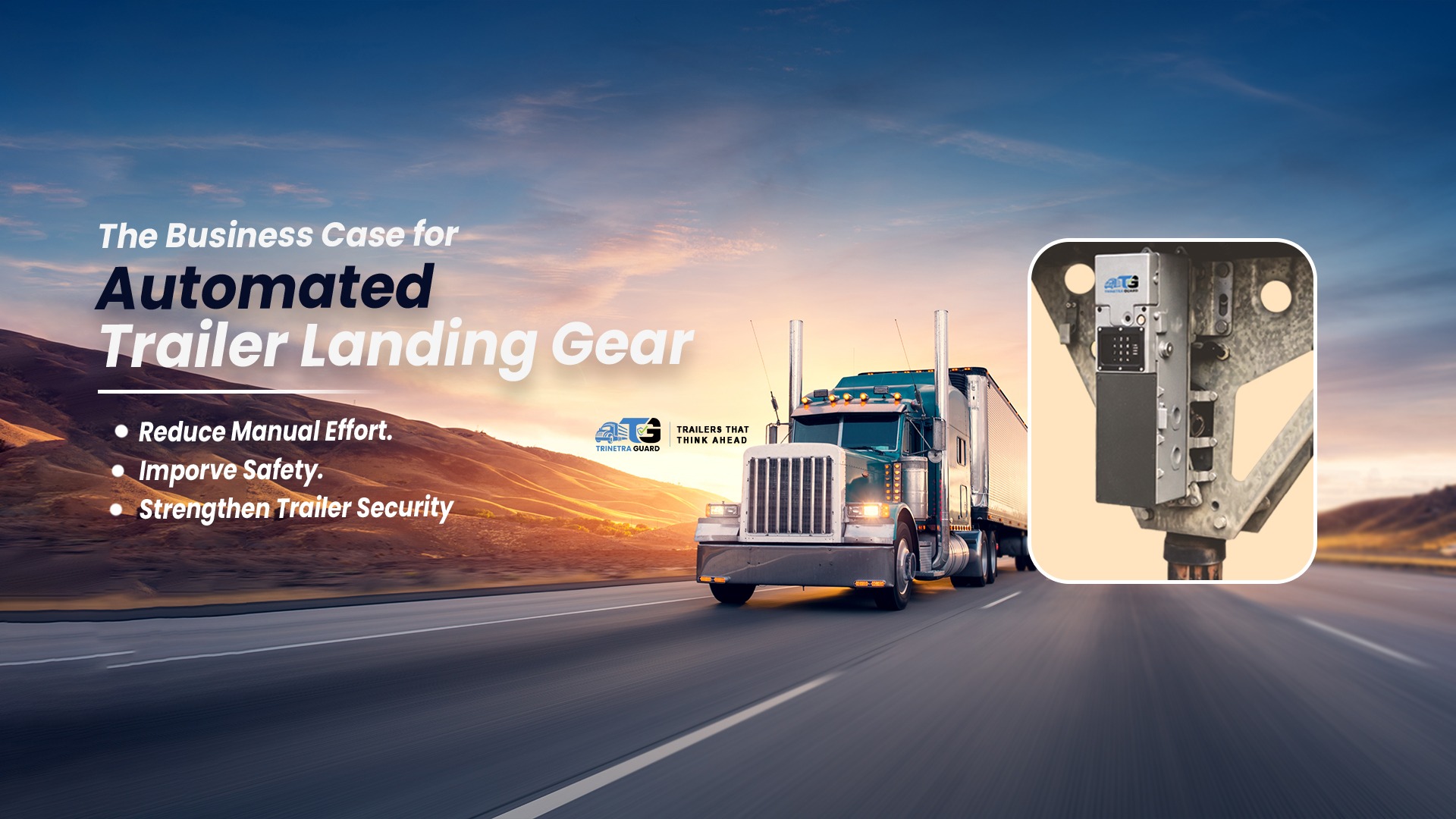
Why Should Fleets Invest in Automated Trailer Landing Gear?
Trucking companies have invested billions in fleet technology, including electronic logging devices, GPS tracking, AI dash cams, route optimization and safety systems.
Yet one important part of trailer operations has remained largely unchanged: manual landing gear cranking.
Drivers still raise and lower semi-trailer landing gear through repeated hand-cranking, often during difficult weather, high-pressure schedules or frequent drop-and-hook operations.
For fleet executives evaluating new technology, an important question arises:
Can automated trailer landing gear deliver enough operational, safety and security value to justify the investment?
The answer requires looking beyond the cost of eliminating manual cranking.
Modern trailer automation can support multiple business priorities, including driver safety, driver retention, trailer security, operational efficiency and asset protection.
When these benefits are combined, automated landing gear becomes more than an equipment upgrade. It becomes a potential fleet-wide investment strategy.
1. Reducing the Hidden Cost of Manual Landing Gear Cranking
Manual landing gear cranking requires physical effort, particularly when the trailer is heavily loaded, equipment is stiff or the ground is uneven.
Drivers may perform this task multiple times during a shift.
For example, a driver handling four trailer exchanges per day performs repeated raising and lowering operations. The physical effort and time involved can accumulate over weeks and months.
The financial implications may include:
- Time spent manually operating landing gear
- Driver fatigue and discomfort
- Increased maintenance attention for difficult equipment
- Potential musculoskeletal injury exposure
- Lost productivity during high-frequency trailer handling
- Driver frustration with repetitive physical tasks
Not every fleet will experience the same cost. A carrier making occasional trailer exchanges may see less operational value than an LTL carrier performing several exchanges every day.
The first step in calculating ROI is measuring how frequently drivers actually operate landing gear.
2. Supporting Driver Injury Prevention
Manual landing gear operation involves repeated arm, shoulder and wrist movements, often with awkward posture or significant force.
Reducing this repetitive effort can support a fleet's broader ergonomic and injury-prevention initiatives.
Driver injuries can create costs beyond medical treatment, including:
- Lost work time
- Workers' compensation expenses
- Temporary driver replacement
- Administrative and claims-related work
- Operational disruption
- Driver dissatisfaction
Automated landing gear is designed to reduce exposure to routine hand-cranking.
However, actual injury reductions and financial savings must be measured. Fleets should not assume a fixed injury-prevention ROI without examining their own claims history and operating conditions.
3. Improving Driver Retention and Recruitment
Truck driver retention is affected by more than wages.
Drivers also evaluate equipment quality, maintenance, working conditions, management support and the physical demands of their jobs.
A fleet that invests in driver-friendly equipment demonstrates that it is willing to improve the daily work experience.
Automated landing gear can offer:
- Less repetitive manual work
- Easier trailer handling
- More comfortable drop-and-hook operations
- A tangible equipment benefit for recruiting
- A potential improvement in driver satisfaction
For fleets working with independent owner-operators, providing easier-to-use trailers may also make those freight opportunities more attractive.
Driver retention improvements cannot be guaranteed. Nevertheless, driver-friendly trailer equipment can contribute to a broader effort to attract and retain experienced drivers.
4. Improving Drop-and-Hook Efficiency
In high-volume trucking operations, time spent on repeated tasks matters.
Automated landing gear may simplify the raising and lowering process during normal trailer exchanges.
Potential operational advantages include:
- Reduced time spent manually cranking
- More consistent landing gear operation
- Less dependence on driver physical effort
- Improved convenience during frequent trailer changes
- More predictable trailer-handling workflows
The actual time savings depend on equipment configuration, trailer conditions, safe operating procedures and the authorization process.
Fleets should measure manual versus automated operation times during pilot testing rather than rely on assumed savings.
5. Cargo Theft Prevention and Trailer Asset Protection
One of the biggest opportunities arises when landing gear automation is combined with physical trailer security.
Traditional manual landing gear supports the trailer when disconnected, but it does not independently authorize who can move that trailer.
Many fleets depend on GPS trackers, manual locks, yard cameras and driver procedures.
These tools are valuable, but GPS alone does not physically prevent an unauthorized tractor from moving a trailer.
EM6000 Auto by Trinetra Guard is designed to combine powered landing gear operation with a physical trailer defense system.
The system helps fleets add another security layer through controlled landing gear operation and authorized access.
Potential business benefits include:
- Lower exposure to unauthorized trailer movement
- Stronger protection for unattended trailers
- Improved security procedures at drop yards
- Better control of high-value freight trailers
- Additional protection for trailer leasing inventory
- Greater fleet-manager visibility into security events
Physical deterrence is not a guarantee against every theft method, including cargo removal, towing or other forms of unauthorized access.
However, making unauthorized trailer movement more difficult can be an important part of cargo theft prevention.
6. Potential Savings From Consolidating Trailer Technology
Many fleets already pay monthly fees for trailer GPS tracking or telematics.
When evaluating a connected trailer security and automation system, fleets should review whether any existing subscriptions or hardware can be replaced.
Possible savings may include:
- Avoided duplicate trailer tracking subscriptions
- Reduced need for separate monitoring hardware
- Simplified vendor management
- Consolidated trailer security information
These savings should only be included in an ROI calculation when EM6000 Auto provides the necessary functionality and the existing services can actually be discontinued.
7. How to Calculate the ROI of Automated Trailer Landing Gear
A useful ROI analysis should evaluate the total value of the system over the trailer's expected remaining service life.
Potential Annual Benefits
|
Benefit Category |
How to Evaluate It |
|
Manual cranking time |
Trailer exchanges × time saved × applicable labor value |
|
Driver safety |
Historical incident data and measured changes in physical effort |
|
Driver retention |
Documented changes in turnover and related recruiting costs |
|
Trailer security |
Historical theft exposure, claims and security improvements |
|
Existing telematics |
Subscriptions that can genuinely be discontinued |
|
Asset utilization |
Measured reductions in operational delays |
|
Insurance |
Written, documented premium or deductible changes, if offered |
Total Investment
Fleets should also account for:
- Device and installation costs
- Monthly or annual service charges
- Maintenance and support
- Driver training
- Equipment compatibility
- Possible transfer costs when trailers are replaced
- Any remaining contractual obligations
A basic financial model is:
Net Financial Benefit = Measurable Operating Savings + Avoided Costs − Total Ownership Costs
The payback period is the time required for cumulative net benefits to recover the initial investment.
Security improvements and driver satisfaction may also create value that is difficult to quantify precisely.
An Example of Time-Savings Measurement
Suppose a fleet estimates that automated landing gear saves three minutes per trailer exchange, and a driver completes four exchanges per day.
That would represent 12 minutes of potential time savings per day, or approximately 44 hours over 220 working days.
This is an illustrative scenario, not a measured EM6000 Auto result. The financial value depends on whether that time translates into actual productive capacity, labor savings or other measurable operating improvements.
For some fleets, driver safety and trailer security may outweigh the value of time savings alone.
8. Trailer Age and Remaining Useful Life Matter
The economics of automation differ between new trailers and existing fleet inventory.
A new trailer may remain in service for many years, potentially allowing a longer period over which to recover the investment.
An older trailer may be scheduled for retirement sooner.
Fleet executives should consider:
- Trailer model year
- Expected retirement date
- Remaining service life
- Utilization
- Landing gear compatibility
- Installation cost
- Opportunities to transfer equipment to a replacement trailer
A trailer-specific evaluation can help fleets select an appropriate deployment strategy.
For new trailers, installation during the manufacturing process may create different cost opportunities than aftermarket installation.
9. Why Leasing Companies Have a Different ROI Opportunity
Trailer leasing companies may evaluate automation and security differently from motor carriers.
Their priorities can include:
- Asset protection
- Unauthorized equipment movement
- Trailer utilization
- Customer differentiation
- Service and maintenance requirements
- Remote authorization capabilities
- Long-term fleet value
EM6000 Auto can potentially provide a leasing company with a more advanced trailer offering that combines driver convenience and security.
Any commercial use of remote lockdown must follow appropriate safety procedures, contractual rights and applicable requirements.
10. EM6000 Auto: A Combined Automation and Security Investment
EM6000 Auto is designed as an autonomous trailer defense and automated landing gear system.
Its design combines several capabilities:
- Powered landing gear operation
- Physical trailer lockdown
- Authorized access through supported controls
- Remote back-office authorization
- GPS visibility and security alerts
- Intelligent battery management
- Driver-friendly trailer handling
This combination changes the business case.
Instead of evaluating only the cost of a motorized crank, fleet executives can evaluate a broader investment in trailer automation, safety, security and fleet control.
Frequently Asked Questions
Is automated trailer landing gear worth the investment?
It depends on trailer utilization, the frequency of trailer exchanges, security exposure, installation costs and measurable operating benefits.
Can landing gear automation reduce workers' compensation costs?
It may support injury-prevention efforts by reducing repetitive manual cranking, but actual claim reductions and insurance savings require documented evidence.
Does EM6000 Auto replace GPS tracking?
EM6000 Auto includes GPS-related visibility capabilities in its design. Fleets should confirm the specific tracking features and whether existing subscriptions can be replaced before including savings in an ROI calculation.
Can automated landing gear be installed on existing trailers?
Compatibility depends on the trailer and landing gear configuration. Trinetra Guard can discuss pilot installations and supported equipment.
Should fleets begin with a pilot?
Yes. A controlled pilot using representative trailers and drivers can help validate operational savings, security functionality, compatibility and driver acceptance.
Conclusion: The Business Case Extends Beyond Automation
The value of automated trailer landing gear should not be measured solely by how much time a driver saves while cranking.
Fleet executives should also consider driver safety, driver experience, cargo theft prevention, asset protection, fleet visibility and the remaining life of the trailer.
EM6000 Auto by Trinetra Guard is designed to combine these benefits in one system.
Automate the landing gear. Help protect the trailer. Reduce driver strain. Strengthen fleet operations.
Evaluate EM6000 Auto for Your Fleet
Learn how trailer automation and physical security can fit your operation.
[Schedule an EM6000 Auto Demonstration]
[Request a Fleet Pilot and ROI Discussion]