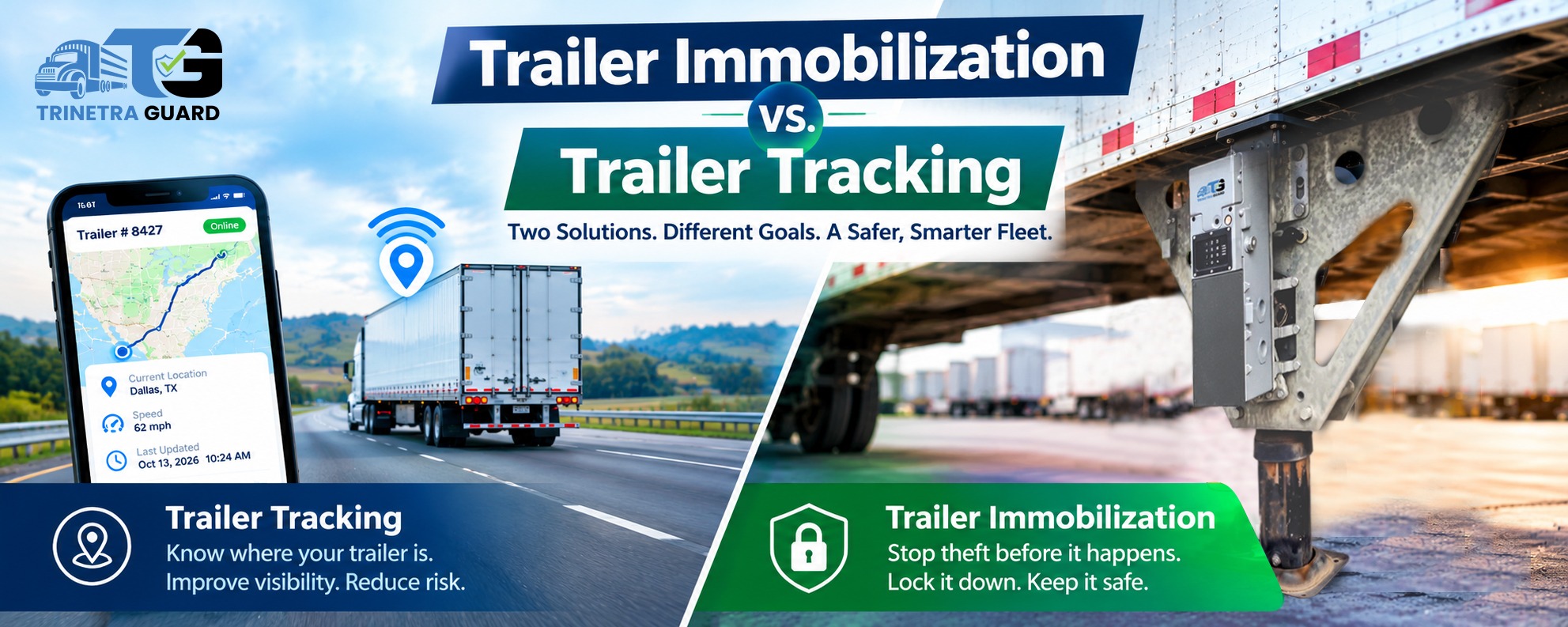
Trailer tracking and trailer immobilization are both important fleet technologies, but they do not solve the same problem.
Trailer tracking helps fleet managers know where a trailer is.
Trailer immobilization helps fleets control whether a trailer should be able to move at all.
That difference matters.
For years, many fleets have relied on GPS trailer tracking as their main trailer security solution. GPS tracking is valuable because it gives location visibility, movement history, geofence alerts, and recovery support.
But GPS tracking alone usually tells a fleet what happened after a trailer has already moved.
Trailer immobilization is different. It is designed to help prevent unauthorized trailer movement before the trailer leaves the yard, customer location, warehouse, or drop site.
For fleet managers dealing with cargo theft, trailer theft, detached trailers, drop yards, leasing inventory, high-value freight, and after-hours trailer movement, understanding the difference between tracking and immobilization is critical.
What Is Trailer Tracking?
Trailer tracking usually refers to GPS-based technology that helps fleets monitor trailer location and movement.
A trailer tracking system may help fleets:
- See trailer location
- Monitor trailer movement
- Set geofence alerts
- Review route history
- Track trailer dwell time
- Identify trailers in yards
- Support recovery if a trailer is moved
- Improve asset visibility
Trailer tracking is useful because fleet managers cannot manage what they cannot see.
If a trailer is sitting in a drop yard, staged near a warehouse, parked at a customer location, or moving across state lines, GPS tracking can help the back office understand where that asset is.
But tracking has a limit.
Tracking does not physically stop an unauthorized person from connecting to the trailer and moving it.
What Is Trailer Immobilization?
Trailer immobilization refers to a physical or electronic security layer designed to help prevent unauthorized trailer movement.
Instead of only reporting where the trailer went, immobilization is designed to make unauthorized movement more difficult.
A trailer immobilization system may support:
- Automatic trailer lockdown
- Authorized access control
- Fleet-controlled permission
- Movement prevention
- Security alerts
- Trailer status visibility
- Integration with GPS or fleet monitoring
- Control from a back-office platform
In simple terms:
Tracking tells you where the trailer is. Immobilization helps control whether the trailer can be moved.
That is why trailer immobilization is especially important for detached trailers, high-value freight, drop yards, warehouse staging, and leasing company inventory.
Why Trailer Tracking Alone May Not Be Enough
GPS tracking is valuable, but it is not the same as theft prevention.
A GPS tracker can tell a fleet:
- The trailer moved
- The trailer left the geofence
- The trailer is heading in an unexpected direction
- The trailer is now in another location
But by the time the alert is triggered, the unauthorized movement may already be happening.
That means the fleet is now reacting.
Reactive security may still help with recovery, but cargo theft prevention should start earlier.
Fleet managers should ask:
- Can we help prevent unauthorized movement before the trailer leaves?
- Can we control who is allowed to move the trailer?
- Can the system secure the trailer automatically after disconnect?
- Can dispatch or the back office authorize movement?
- Can we reduce dependence on manual locks or driver memory?
- Can we receive alerts before the situation becomes a loss?
This is where trailer immobilization becomes more valuable.
Tracking vs. Immobilization: Key Differences
|
Area |
Trailer Tracking |
Trailer Immobilization |
|
Main function |
Shows location |
Helps prevent unauthorized movement |
|
Security type |
Visibility |
Physical prevention and access control |
|
Best use |
Monitoring and recovery |
Prevention and control |
|
When it helps |
After or during movement |
Before unauthorized movement |
|
Depends on response time |
Yes |
Less dependent on fast recovery response |
|
Helps with geofencing |
Yes |
Can work with geofencing and alerts |
|
Helps physically secure trailer |
No, not by itself |
Yes, by design |
|
Best for |
Asset visibility |
Theft prevention and trailer control |
The strongest trailer security strategy uses both.
GPS tracking helps fleets see the trailer. Immobilization helps fleets secure it.
Why Detached Trailers Need Immobilization
Detached trailers are one of the highest-risk points in trucking operations.
When a trailer is disconnected from the tractor, the driver may leave. The trailer may sit unattended for hours, days, or longer.
Detached trailers are commonly found at:
- Drop yards
- Customer yards
- Distribution centers
- Warehouses
- Truck stops
- Remote lots
- Overflow parking areas
- Leasing company yards
- High-value freight staging areas
If an unauthorized tractor can connect to that trailer and move it, GPS may only show where the trailer went after the fact.
Immobilization adds another layer by helping secure the trailer when it is disconnected and helping control authorized movement.
Why Manual Locks Are Not Always Enough
Manual locks can be useful, but they depend on people remembering to use them correctly every time.
In real fleet operations, manual security steps may be missed because:
- Drivers are rushed
- Yards are busy
- Locks are misplaced
- Locks are damaged
- Procedures are not followed consistently
- Weather or poor lighting creates difficulty
- Drivers assume someone else handled the security step
- Multiple teams interact with the same trailer
Manual locks also may not provide real-time visibility to the back office.
Fleet managers may not know:
- Whether the lock was applied
- Who accessed the trailer
- Whether a trailer was moved with permission
- Whether a security event occurred
- Whether dispatch needs to intervene
That is why automated or connected trailer immobilization can be valuable.
How EM6000 Auto Supports Trailer Immobilization
EM6000 Auto by Trinetra Guard is designed as an autonomous trailer defense and landing gear automation system.
It is built to help fleets go beyond basic GPS tracking by combining trailer automation, security, access control, and fleet visibility.
EM6000 Auto is designed to support:
- Automated trailer landing gear operation
- Auto-lockdown security after disconnect
- Authorized access workflows
- GPS visibility
- Fleet-controlled trailer access
- Security alerts
- Back-office control
- Unauthorized movement prevention
- Driver-friendly trailer operation
Instead of only showing where a trailer went, EM6000 Auto is designed to help fleets control whether a trailer should be moved in the first place.
Why Fleet Managers Should Combine Tracking and Immobilization
Trailer tracking and trailer immobilization are not competitors. They work best together.
A complete trailer security strategy should include:
- GPS location visibility
- Geofence alerts
- Movement alerts
- Door and tamper alerts
- Authorized access workflows
- Trailer immobilization
- Back-office control
- Driver procedures
- Yard security
- High-value freight procedures
Tracking gives visibility. Immobilization adds prevention. Together, they help fleets respond faster and reduce risk.
Who Needs Trailer Immobilization?
Trailer immobilization is especially useful for:
- Trucking companies that own trailers
- Trailer leasing companies
- High-value freight carriers
- Private fleets
- Regional carriers
- Drop-and-hook operations
- Shippers with staged trailers
- Warehouses and distribution centers
- Fleets with detached trailers
- Fleets with theft exposure
- Risk-management teams
- Insurance-focused operations
If trailers sit unattended, detached, loaded, or exposed, immobilization should be considered.
Final Thoughts
Trailer tracking is important, but tracking alone is not the same as security.
GPS tells fleets where a trailer is. Immobilization helps control whether that trailer can move without authorization.
For fleet managers, the better question is not whether to use tracking or immobilization.
The better question is:
How can we combine visibility, alerts, access control, and physical prevention to protect trailers before a loss occurs?
EM6000 Auto by Trinetra Guard is designed to support that next level of trailer security by combining landing gear automation, trailer lockdown, authorized access, GPS visibility, and fleet control.