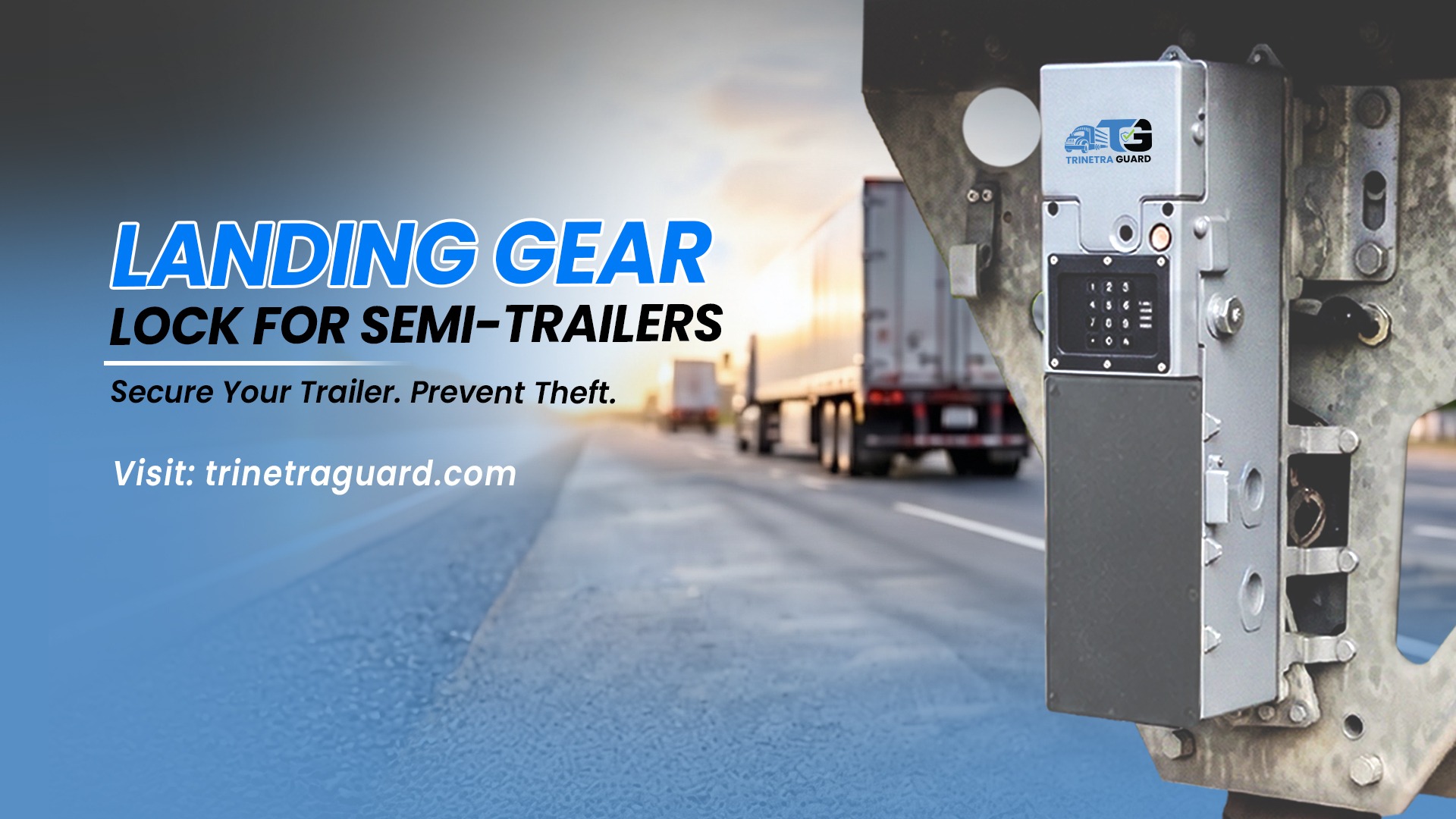
Can a Landing Gear Lock Help Prevent Trailer Theft?
A loaded semi-trailer can be an attractive target for cargo thieves, especially when it is parked unattended at a truck stop, distribution center, warehouse or drop yard.
Many trucking companies use GPS trackers to monitor trailer locations.
But GPS tracking does not physically prevent an unauthorized person from attempting to connect a tractor and move the trailer.
A landing gear lock adds a physical security layer by restricting normal operation of the trailer's supporting legs.
When properly designed and engaged, a landing gear locking system can make a conventional unauthorized trailer hookup more difficult.
Advanced technology can take this concept further by combining the locking mechanism with automated landing gear, electronic authorization and connected monitoring.
That is the approach behind EM6000 Auto by Trinetra Guard.
What Is a Trailer Landing Gear Lock?
A trailer landing gear lock is a mechanical or electronically controlled security device designed to restrict unauthorized operation of semi-trailer landing gear.
To understand its purpose, consider how traditional trailer landing gear works.
When a semi-trailer is disconnected from its tractor, landing gear supports the front of the trailer.
During a normal pickup, an authorized driver must follow the correct coupling procedure, which includes positioning the tractor, completing the coupling and connection checks, and raising the landing gear before travel.
If the landing gear cannot be operated normally without authorization, an unauthorized pickup becomes more difficult.
Unlike a GPS tracker, which primarily provides information, a landing gear lock creates a physical operating restriction.
The amount of protection depends on the design, installation, condition and operating environment.
How Does a Landing Gear Lock Work?
Landing gear locking systems vary.
Some use mechanical devices that restrict a crank handle or related mechanism.
More advanced systems can integrate powered operation with electronic controls and physical locking features.
A connected system may support the following general workflow:
1. The Trailer Is Parked
The driver positions the trailer in an approved location, follows safe uncoupling procedures and leaves the landing gear supporting the trailer.
2. The Security System Is Engaged
The trailer's landing gear security mechanism enters its secured state.
The system is designed to restrict normal unauthorized landing gear operation.
3. An Authorized Pickup Is Requested
A driver or fleet manager uses an approved authorization method to request operation.
Depending on the technology, this may involve an app, approved wireless device, keypad or back-office control.
4. Authorized Landing Gear Operation Is Enabled
After the required authorization, the landing gear can be operated through the supported process.
5. The Trailer Is Moved Through Normal Procedures
The driver completes the required coupling and safety checks before departing.
The main security benefit is not that a locked trailer becomes physically impossible to move. It is that normal unauthorized landing gear operation becomes more difficult.
Why Traditional GPS Tracking Is Not Enough
GPS tracking is one of the most widely used trailer management technologies.
It can help fleet managers:
- Locate trailers
- Monitor movement
- Review location history
- Receive geofence alerts
- Investigate unauthorized activity
- Support recovery efforts
But tracking does not automatically prevent a conventional unauthorized pickup.
A trailer may already have left the yard when a location alert reaches the fleet manager.
A physical landing gear security system adds another preventive layer.
Tracking vs. Physical Trailer Security
|
Feature |
GPS Tracker |
Landing Gear Lock |
|
Provides location information |
Yes |
Not necessarily |
|
Generates movement alerts |
Often |
Only with connected features |
|
Restricts normal landing gear operation |
No |
Yes, by design |
|
Helps complicate conventional unauthorized hookup |
Indirectly |
Yes |
|
Supports investigations |
Yes |
Depends on system |
|
Can guarantee prevention of all theft methods |
No |
No |
Combining connected tracking and physical security provides a broader approach to trailer protection.
Landing Gear Lock vs. Kingpin Lock: What's the Difference?
A kingpin lock and a landing gear lock address different parts of a semi-trailer.
Kingpin Lock
A kingpin lock is designed to obstruct access to the trailer's kingpin and make conventional tractor coupling more difficult.
Advantages can include direct physical coupling deterrence and relatively straightforward use.
However, manual kingpin locks must be correctly installed, removed, maintained and stored.
Landing Gear Lock
A landing gear lock restricts normal operation of the trailer's supporting mechanism.
Its purpose is to create an obstacle to unauthorized landing gear operation and conventional trailer pickup.
Depending on the design, the security function can be integrated with powered automation and electronic authorization.
Which Is Better?
Neither should be treated as universally superior.
A kingpin lock targets coupling. A landing gear lock targets landing gear operation. High-security trailer door locks protect cargo access.
The appropriate combination depends on the fleet's operating procedures, trailer equipment, exposure to theft and driver requirements.
Introducing EM6000 Auto: Automated Landing Gear With Integrated Trailer Security
EM6000 Auto by Trinetra Guard is designed to go beyond a conventional landing gear locking device.
The system combines powered trailer landing gear operation with a physical trailer defense mechanism and connected authorization features.
Its central concept is straightforward:
Only authorized users should be able to perform normal controlled landing gear operations on a secured trailer.
The system is designed to support:
- Automated raising and lowering of compatible trailer landing gear
- Physical landing gear lockdown
- Authorized operation through supported controls
- Mobile application and back-office authorization
- Bluetooth-based trusted-truck access options
- Keypad and one-time-password access options
- GPS visibility and security alerts
- Intelligent power management
Some capabilities are configuration-dependent or part of ongoing product development.
This approach creates a distinction between EM6000 Auto and a standalone mechanical lock.
It is designed to serve as both a trailer operating system and a physical security layer.
Why Automated Locking Can Be Valuable for Busy Fleets
Traditional physical locks often require drivers to perform additional manual actions.
Drivers may have to retrieve a lock, install it, secure it, remove it before departure and store it.
If those steps are forgotten or incorrectly performed, the intended protection may not be in place.
An integrated electronic security workflow can reduce dependence on some separate manual locking procedures.
For example, a fleet manager may authorize a trailer pickup through the connected system rather than relying solely on physical possession of a key.
The operational benefits may include:
Centralized Authorization
Fleet managers can manage approved users and supported access permissions.
Greater Operational Consistency
Defined authorization workflows can support more consistent trailer-security procedures.
Driver Convenience
Powered landing gear reduces routine manual cranking during normal operations.
Security Visibility
Connected alerts can help fleet personnel identify certain unexpected activity.
Fleet-Wide Management
A common security workflow can be useful for operations managing multiple trailers and locations.
These advantages must be evaluated in a real fleet environment, with appropriate training and security procedures.
How Trailer Landing Gear Locking Supports Cargo Theft Prevention
Cargo theft can occur through several methods.
Some incidents involve the unauthorized movement of an entire trailer.
Others involve theft of cargo through trailer doors, fraudulent pickups, impersonation or other supply-chain schemes.
A landing gear lock is especially relevant to scenarios involving an attempt to collect a parked trailer through conventional coupling procedures.
It does not independently secure trailer doors, verify all freight documentation or eliminate every method of moving a trailer.
For that reason, fleet managers should combine landing gear security with:
- High-security cargo door locks
- Driver and pickup identity checks
- GPS tracking and geofencing
- Yard access control
- Security cameras
- Dispatch authorization
- Emergency response procedures
The strongest strategy is to make unauthorized access, pickup and movement progressively more difficult—not depend on one device.
Why Landing Gear Automation Also Matters for Driver Safety
Traditional trailer landing gear requires repeated manual cranking.
Drivers may need to operate the crank several times a day, especially during frequent drop-and-hook operations.
This can involve repetitive arm, shoulder and wrist movement.
Powered landing gear reduces the need for that routine manual effort.
That creates an additional advantage beyond security.
For fleet managers, investing in EM6000 Auto may support two business objectives:
Trailer security: Help deter unauthorized conventional pickup and movement.
Driver experience: Reduce repetitive manual landing gear cranking.
This combination can be especially relevant for high-frequency drop-and-hook operations, LTL carriers, distribution fleets and trailer leasing companies.
What Should Fleet Managers Look for in a Landing Gear Security System?
Before choosing a solution, consider the following questions.
Is the Device Compatible With Existing Landing Gear?
Confirm the manufacturer, model, mounting arrangement and mechanical requirements.
How Is Access Authorized?
Understand how drivers and fleet managers obtain operating permission.
What Happens When Connectivity Is Unavailable?
Review the supported offline, recovery and emergency procedures.
What Happens if the Battery Is Depleted?
Understand the power architecture, backup procedures and operating limitations.
Can the System Be Monitored?
Determine whether location visibility, authorization events and security alerts are available.
Does It Reduce Manual Cranking?
A system combining security and automation may offer additional operational benefits.
Is the System Safe for Trailer Operations?
Confirm that the installation and use comply with the equipment manufacturer's instructions and safe coupling and uncoupling procedures.
Frequently Asked Questions
What is a landing gear lock on a semi-trailer?
A landing gear lock is a security mechanism designed to restrict unauthorized normal operation of the trailer's landing gear.
Can a landing gear lock stop trailer theft?
It can make conventional unauthorized pickup more difficult, but it cannot guarantee prevention of every theft or towing method.
Is a landing gear lock the same as a kingpin lock?
No. A kingpin lock targets the tractor-trailer coupling point, while a landing gear lock restricts operation of the landing gear mechanism.
Does EM6000 Auto automatically operate trailer landing gear?
EM6000 Auto is designed to provide powered raising and lowering of compatible semi-trailer landing gear, reducing routine manual cranking.
Can a fleet manager authorize operation remotely?
EM6000 Auto supports connected authorization concepts. The exact controls available depend on the system configuration and deployment.
Does the system also include GPS tracking?
EM6000 Auto incorporates connected location visibility and security-alert capabilities in its design. Fleets should confirm the functions available in the proposed configuration.
Conclusion: From Simple Trailer Locks to Intelligent Trailer Defense
Traditional trailer security has relied heavily on locks, GPS trackers and manual operating procedures.
Each remains useful.
But newer systems create an opportunity to combine physical security with automation and approved access control.
EM6000 Auto by Trinetra Guard is designed to bring these capabilities together by integrating powered landing gear with a physical trailer defense mechanism.
For fleets seeking better trailer security and more driver-friendly operations, that combination deserves consideration.
Go Beyond Tracking. Add Physical Trailer Defense. Eliminate Routine Manual Cranking.
Explore the EM6000 Auto Landing Gear Security System
Learn how Trinetra Guard's automated landing gear and trailer-security technology may fit your fleet.
[Request a Live EM6000 Auto Demo]