Why Drop Yard Security Is Critical for Trucking Fleets
Drop yards are essential to modern trucking operations.
They allow carriers to stage trailers, exchange equipment, manage freight movements and improve operational flexibility.
Instead of waiting for a trailer to be unloaded, a driver can drop one trailer and connect to another.
While this improves efficiency, it also creates security challenges.
A trailer may remain disconnected and unattended for hours or days. During that period, cargo and equipment can be exposed to unauthorized access, fraudulent pickup, theft or vandalism.
Many yards also operate with limited staffing during nights, weekends and holidays.
A strong drop yard security program must protect both the facility and the individual trailers parked inside it.
The following checklist can help fleet managers, terminal operators and security teams evaluate their current procedures.
1. Secure the Yard Perimeter
The first level of protection is controlling unauthorized entry.
Fleet operators should evaluate whether the property has suitable physical barriers and whether those barriers are maintained.
Perimeter Security Checklist
· Inspect perimeter fencing and identify damaged sections.
· Secure gates when they are not actively being used.
· Limit entry and exit points where practical.
· Identify blind spots and areas accessible from adjoining properties.
· Maintain adequate lighting around gates and parking areas.
· Use appropriate warning signs and access restrictions.
· Review security procedures during nights, weekends and holidays.
A perimeter fence is a useful deterrent, but it should not be the only security measure.
Large yards may require additional patrols, cameras, monitored gates or other safeguards.
2. Control Driver, Visitor and Vehicle Access
Unauthorized access can occur when identification and pickup procedures are weak.
Yard operators should establish clear policies for verifying who is entering the facility and which equipment they are authorized to collect.
Access Control Checklist
· Verify driver and carrier identification.
· Confirm the trailer number and pickup authorization.
· Record tractor and trailer information.
· Maintain a record of entry and exit events.
· Verify unexpected changes in pickup instructions.
· Restrict access to sensitive freight information.
· Revoke access when credentials are no longer needed.
· Establish procedures for unidentified or unauthorized vehicles.
These practices are particularly important for yards used by multiple carriers, independent owner-operators and third-party transportation providers.
A connected trailer authorization system can support the process by adding control over who is permitted to perform certain trailer operations.
3. Improve Lighting and Camera Coverage
Surveillance systems can help deter suspicious activity and provide useful information during incident investigations.
However, cameras are only effective when they cover relevant areas and recordings can be accessed when needed.
Surveillance Checklist
· Monitor entrances and exits.
· Cover trailer parking areas and high-value freight zones.
· Review camera blind spots.
· Maintain sufficient nighttime lighting.
· Check recording equipment regularly.
· Restrict access to surveillance footage.
· Establish appropriate video retention procedures.
· Determine who reviews alerts and suspicious activity.
Where possible, camera coverage should support identification of vehicles, trailers and individuals entering or leaving the yard.
4. Use Physical Security for Parked Trailers
Even a well-secured yard can experience unauthorized access.
Physical trailer security adds another layer of protection if someone reaches a parked trailer.
Trailer Security Checklist
· Confirm that each trailer is parked in an approved location.
· Follow proper landing gear and parking procedures.
· Secure trailer cargo doors using appropriate equipment.
· Use suitable kingpin or other physical locks where required.
· Check that installed trailer security systems are engaged.
· Verify the condition of locks and security devices.
· Apply additional controls to high-value or high-risk freight.
· Document trailer status when equipment is dropped.
How Landing Gear Security Adds Protection
A conventional semi-trailer uses landing gear to support the front of the trailer after disconnection.
A landing gear security mechanism can restrict normal unauthorized operation of that equipment.
This can make conventional unauthorized trailer pickup more difficult.
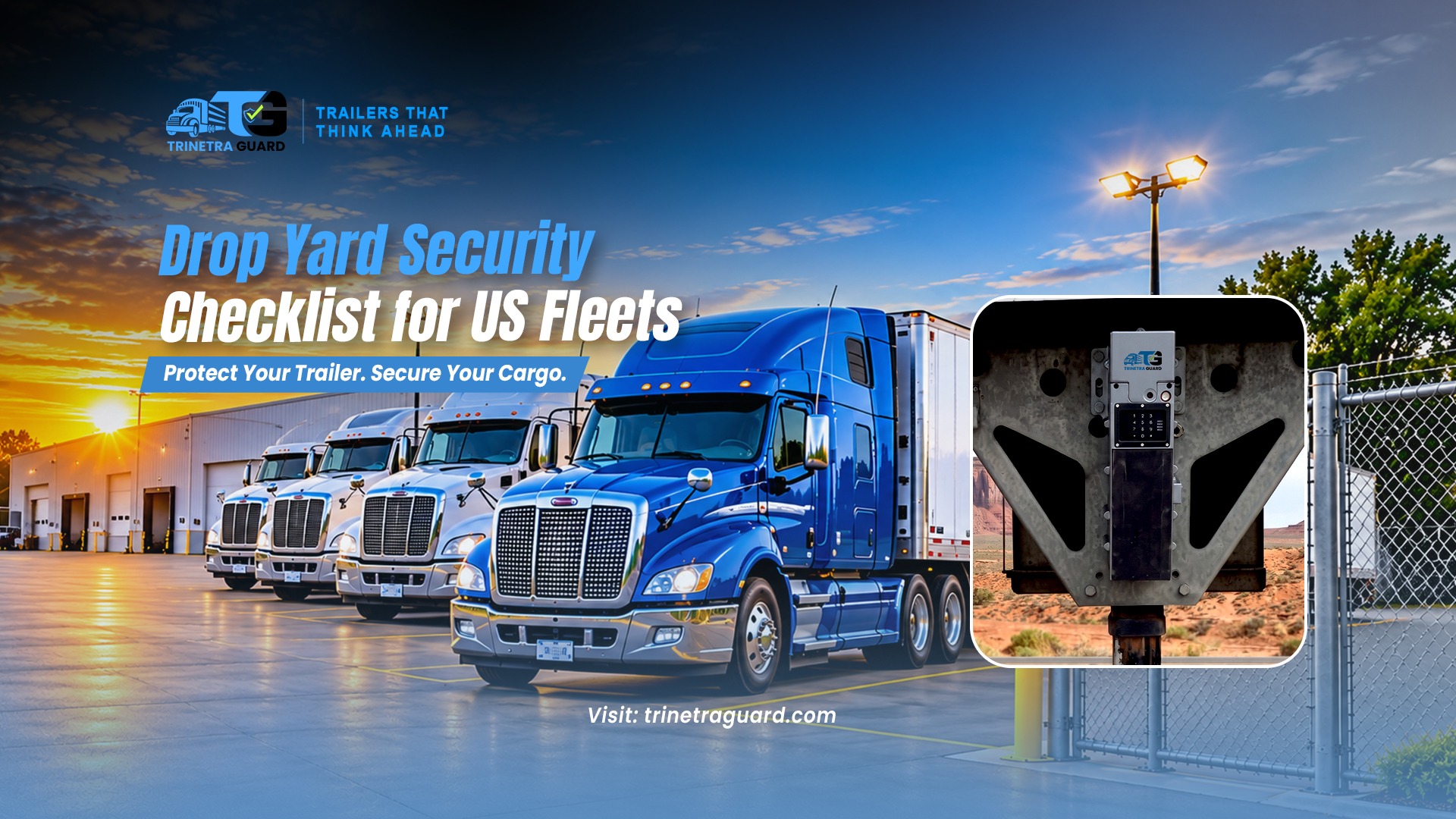
Trinetra Guard's EM6000 Auto is designed to combine automated trailer landing gear with physical trailer lockdown and controlled access.
It allows fleets to evaluate both trailer security and driver convenience through one connected system.
Physical trailer defense should be combined with door security, yard controls and identity verification rather than treated as a standalone guarantee.
5. Monitor Trailers With GPS and Geofencing
Drop yard security should not depend only on visual inspections or periodic security patrols.
Connected trailer monitoring can help fleet managers maintain visibility across multiple locations.
GPS and Telematics Checklist
· Maintain accurate trailer location information.
· Configure appropriate geofences around yards.
· Enable relevant unexpected movement alerts.
· Assign personnel to review alerts.
· Check device connectivity and battery status.
· Maintain correct trailer-to-device records.
· Investigate unexplained location changes.
· Review security-event history periodically.
For large fleets, alerts should be prioritized to minimize unnecessary notifications while ensuring that important events receive attention.
A fleet should also establish backup procedures for times when cellular coverage or device connectivity is unavailable.
6. Verify Trailer Assignments Before Pickup
Busy drop yards may contain hundreds or thousands of trailers.
Drivers may arrive at unfamiliar facilities and work under tight schedules.
Incorrect trailer pickups can cause significant delays and may create security concerns.
Trailer Assignment Checklist
· Confirm the assigned trailer number.
· Verify the destination and dispatch instructions.
· Confirm that the driver is authorized to collect the trailer.
· Check the tractor and trailer identification.
· Record departure and destination details.
· Investigate discrepancies before releasing equipment.
· Maintain procedures for last-minute assignment changes.
Connected authorization can complement these checks by adding an additional permission-based control.
For example, fleet managers may authorize supported trailer operations only for approved personnel.
This can be useful for fleets operating across multiple customer yards and distribution centers.
7. Establish After-Hours and Weekend Security Procedures
Security risks do not disappear when a facility closes.
Drop yards may have reduced staffing during nights, weekends and major holidays.
Fleet managers should evaluate what happens when an alert occurs outside regular business hours.
After-Hours Security Checklist
· Identify who monitors the yard outside business hours.
· Assign backup contacts.
· Establish escalation procedures.
· Confirm that cameras and alarms remain operational.
· Restrict unauthorized after-hours pickups.
· Monitor high-value loaded trailers.
· Review trailer movements occurring outside expected hours.
· Document and investigate unusual activity.
Monitoring without a clear response procedure can leave a dangerous gap in the security program.
8. Protect High-Value and High-Risk Cargo
Not every shipment presents the same theft exposure.
Electronics, pharmaceuticals, consumer goods, metals and other valuable freight may require additional protection depending on shipment conditions and current theft patterns.
Fleet managers should establish risk-based procedures.
High-Value Cargo Checklist
· Identify shipments requiring enhanced security.
· Limit unnecessary disclosure of cargo information.
· Use suitable trailer locks and security seals.
· Park high-risk trailers in designated secured areas.
· Verify the identity of pickup personnel.
· Monitor unexpected movement.
· Restrict unnecessary dwell time where practical.
· Establish an incident escalation plan.
Risk-based trailer security can help allocate resources where they are most needed.
9. Maintain Security Equipment and Driver Training
Security controls require ongoing maintenance.
A camera that no longer records, a damaged gate or a disconnected tracker may create a vulnerability.
Maintenance and Training Checklist
· Inspect physical locks and security equipment.
· Confirm that connected trailer devices are functioning.
· Maintain landing gear according to manufacturer requirements.
· Train drivers on approved trailer securing procedures.
· Review access-control procedures.
· Train employees to identify suspicious pickup requests.
· Conduct periodic security reviews.
· Document corrective actions.
Driver safety remains essential.
Security procedures must not encourage unsafe trailer handling or unauthorized equipment operation.
10. Prepare a Cargo Theft Incident Response Plan
Even strong preventive measures cannot eliminate every risk.
Every fleet should have a clear response process for suspected trailer theft or unauthorized movement.
Incident Response Checklist
· Confirm the affected trailer's identification.
· Review available location and security information.
· Contact law enforcement when theft is suspected.
· Notify the appropriate internal security or operations manager.
· Contact the insurer as required by policy conditions.
· Preserve camera footage and relevant records.
· Notify affected customers when appropriate.
· Review the incident and update preventive procedures.
Employees should not attempt to confront suspected thieves or pursue stolen equipment in a manner that puts people at risk.
Why Traditional Yard Security May Not Be Enough
Consider a trailer parked at a distribution center overnight.
The yard may have a perimeter fence, cameras and GPS tracking.
These measures are valuable, but they serve different purposes.
The fence helps control entry.
The cameras provide surveillance.
The GPS tracker helps detect or locate movement.
A physical trailer security system can add another obstacle to unauthorized conventional pickup.
The strongest drop yard security programs combine facility protection with trailer-level security.
This is especially important when trailers move between yards operated by different carriers, warehouses and customers.
EM6000 Auto: Adding Trailer-Level Protection to Drop Yard Security
EM6000 Auto by Trinetra Guard is designed to address two important issues found in drop-and-hook and drop yard operations.
Physical Trailer Defense
The system integrates a controlled landing gear locking mechanism designed to restrict unauthorized normal operation.
This can make conventional unauthorized pickup more difficult when the trailer is disconnected.
Automated Landing Gear
Powered landing gear operation reduces the need for routine manual cranking.
This can improve driver convenience during repeated trailer exchanges.
Controlled Authorization
Supported and planned configurations provide authorization methods that may include mobile, back-office, Bluetooth and keypad-based workflows.
Connected Monitoring
GPS visibility and security-alert capabilities can help fleet managers maintain awareness of trailer activity.
The goal is to bring security, automation and fleet control together in a single trailer technology approach.
Availability of specific capabilities depends on equipment configuration and deployment readiness.
Why Drop Yard Security Matters for Trailer Leasing Companies
Trailer leasing companies may have equipment distributed across multiple customers and locations.
A leased trailer may be parked in a facility that the leasing company does not directly operate.
This can make asset security and access management more challenging.
Connected physical trailer security can provide an additional option for:
- Protecting leased equipment
- Monitoring unexpected movement
- Supporting authorized trailer access
- Improving asset visibility
- Differentiating leasing equipment
- Supporting customer security procedures
Any remote access restriction or lockdown capability must be used safely and in accordance with applicable contractual rights and operating procedures.
A Practical Drop Yard Security Review
Fleet managers should periodically evaluate their security controls rather than assume existing measures remain effective.
A useful review can include:
Physical security: Fences, gates, lighting and camera systems.
Trailer-level protection: Locks, landing gear security and cargo doors.
Technology: GPS monitoring, alert management and access controls.
Operations: Driver verification, trailer assignments and after-hours procedures.
People: Training, reporting responsibilities and incident response.
For larger networks, consider using a standardized checklist across all yards and customer locations.
Frequently Asked Questions
How do trucking companies secure drop yards?
Common measures include fences, gates, lighting, surveillance cameras, driver identification, trailer locks, GPS tracking and documented security procedures.
Are drop yards vulnerable to trailer theft?
Yes. Unattended trailers, high-value freight and inconsistent access-control procedures can create security exposure.
Can GPS tracking protect trailers at drop yards?
GPS tracking helps monitor equipment and detect unexpected movement, but it does not physically prevent unauthorized movement.
What is the benefit of a landing gear locking system at a drop yard?
It can restrict normal unauthorized operation of trailer landing gear, making conventional unauthorized trailer pickup more difficult.
Can EM6000 Auto be used for drop-and-hook operations?
EM6000 Auto is designed for compatible semi-trailer landing gear and can support automated operations and security workflows relevant to drop-and-hook activity.
Should fleets secure empty trailers?
Yes. Empty trailers are valuable assets and may also be exposed to unauthorized movement, damage or theft.
Conclusion: Secure the Yard and the Trailer
Drop yard security requires more than cameras, fencing or GPS tracking alone.
A strong program combines facility security, driver verification, connected monitoring, physical trailer protection and consistent operating procedures.
For fleets managing trailers across multiple locations, trailer-level security becomes especially important.
EM6000 Auto by Trinetra Guard is designed to add physical trailer defense and automated landing gear operation to this broader security strategy.
Secure the yard. Control trailer access. Help prevent unauthorized movement.
Improve Security Across Your Trailer Network
Explore how EM6000 Auto can support trailer security at drop yards, distribution centers and customer facilities.
[Schedule an EM6000 Auto Demonstration]
[Discuss a Trailer Security Pilot]