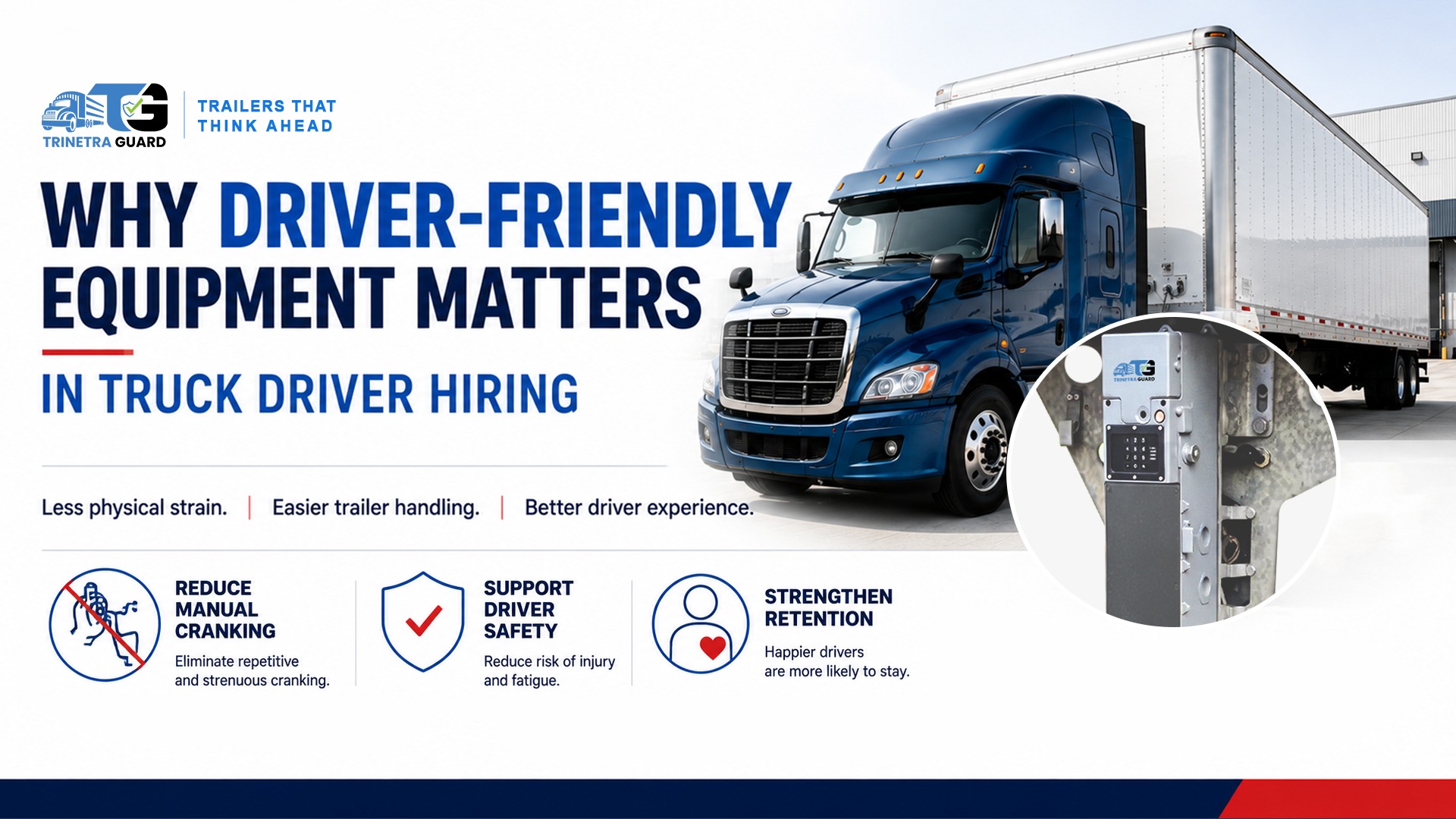
Truck driver hiring is difficult.
Fleets compete for experienced drivers, safe drivers, owner-operators, and drivers who can handle demanding routes and real-world freight operations. Many companies try to improve hiring by focusing on pay, bonuses, home time, and recruiting ads.
Those things matter.
But equipment also matters.
Drivers judge a company by the tools they are given every day. A fleet can say it values drivers, but if the equipment is outdated, physically demanding, uncomfortable, or frustrating, drivers notice.
Driver-friendly equipment can become a real hiring advantage.
That includes modern ELD systems, AI dash cams that protect drivers with video evidence, reliable GPS tools, easy-to-use mobile apps, and trailer technology that reduces unnecessary physical strain.
One overlooked example is trailer landing gear.
Manual trailer cranking is still a normal part of many drivers’ daily work. But just because something is normal does not mean it should be ignored.
Landing gear automation can help fleets create a more driver-friendly operation and strengthen the message they bring to driver recruiting.
Hiring Drivers Is Not Only About Pay
Pay is one of the first things drivers compare, but it is not the only reason they choose or leave a company.
Drivers also care about:
- Equipment quality
- Safety culture
- Dispatch respect
- Route consistency
- Home time
- Maintenance support
- Technology usability
- Driver support
- Physical workload
- Whether the company keeps promises
A fleet that offers competitive pay but gives drivers difficult equipment may still struggle with hiring and retention.
A fleet that invests in better equipment can stand out.
Driver-friendly equipment gives recruiters something specific to talk about instead of relying only on generic claims like “we treat drivers like family.”
What Is Driver-Friendly Equipment?
Driver-friendly equipment means technology and tools that make the driver’s work safer, easier, more efficient, and less frustrating.
Examples include:
- Easy-to-use ELD systems
- AI dash cams that provide video evidence
- Reliable GPS and dispatch visibility
- Mobile apps that reduce paperwork
- Automated trailer landing gear
- Well-maintained tractors and trailers
- Clear inspection tools
- Trailer security systems
- Support teams available when drivers need help
Driver-friendly equipment should reduce friction in the driver’s day.
That matters because drivers remember the small daily problems that make the job harder.
Why Manual Trailer Cranking Affects Driver Experience
Manual trailer cranking may seem like a small task, but drivers experience it differently.
A driver may need to crank landing gear:
- During drop-and-hook operations
- At customer locations
- At warehouses
- In crowded yards
- In bad weather
- After long driving hours
- When the trailer is loaded
- When the landing gear is stiff
- When the ground is uneven
This repeated task can create strain on the shoulders, arms, wrists, back, and neck.
Even when it does not result in a formal injury claim, manual cranking can still create fatigue, frustration, and dissatisfaction.
Drivers may ask themselves:
Why is everything else becoming automated, but I am still hand-cranking the trailer?
That question matters in hiring.
How Driver-Friendly Equipment Supports Hiring
Driver-friendly equipment can support hiring in several ways.
1. It Creates a Stronger Recruiting Message
Recruiters need something real to say.
Instead of only saying, “We care about drivers,” a fleet can say:
We are investing in automated trailer landing gear to reduce manual cranking strain.
That is specific. Drivers understand it immediately.
2. It Shows Respect for Driver Effort
Drivers want to feel that management understands the physical reality of the job.
Reducing manual cranking shows that the fleet is paying attention to the driver’s daily experience.
3. It Helps Attract Experienced Drivers
Experienced drivers may be more selective about equipment and working conditions.
A fleet with driver-friendly equipment can appeal to drivers who want to continue working without unnecessary physical strain.
4. It Can Support Owner-Operator Interest
Owner-operators care about efficiency, equipment, and daily usability.
Technology that reduces effort and improves trailer security can make a fleet, shipper, or leasing partner more attractive.
5. It Supports a Modern Fleet Image
Drivers know when a company is investing in modern tools.
Automated landing gear, AI dash cams, ELD integration, GPS visibility, and trailer security all help position the fleet as forward-thinking.
Driver-Friendly Equipment and Retention Work Together
Hiring and retention are connected.
If a fleet attracts drivers but does not improve the daily work experience, drivers may still leave.
Equipment affects both:
- A driver’s decision to join
- A driver’s decision to stay
Driver-friendly equipment can help reduce frustration, support safety, and improve morale.
Landing gear automation is one example because it addresses a physical task drivers already understand.
Landing Gear Automation as a Hiring Advantage
Landing gear automation can support hiring by giving fleets a clear driver-focused benefit.
Instead of asking drivers to manually crank landing gear again and again, fleets can offer technology designed to automate the process.
This can help communicate:
- Less manual cranking
- Less repetitive physical strain
- Easier trailer handling
- More modern equipment
- Better driver experience
- Stronger safety culture
For driver recruiting, this is a practical message.
It is not a slogan. It is a real equipment improvement.
Women Drivers and Broader Driver Recruitment
The trucking industry continues to look for ways to attract a broader driver population.
Driver-friendly equipment can help by reducing unnecessary physical barriers in trailer operations.
Landing gear automation should not be positioned as only for one group of drivers. It benefits all drivers.
But reducing manual cranking can support a more inclusive equipment strategy and help fleets show that they are thinking seriously about driver comfort, safety, and accessibility.
That can matter in recruiting conversations.
How EM6000 Auto Supports Driver-Friendly Fleet Operations
EM6000 Auto by Trinetra Guard is designed to automate trailer landing gear while also supporting trailer security and access control.
For driver hiring and retention, EM6000 Auto can help fleets tell a stronger story:
- We are reducing manual trailer cranking.
- We are investing in driver-friendly equipment.
- We are improving trailer security.
- We are giving the back office better trailer control.
- We are modernizing trailer operations, not only truck operations.
EM6000 Auto is designed to support:
- Automated landing gear operation
- Reduced manual cranking strain
- Auto-lockdown trailer security
- Authorized trailer access
- GPS visibility
- Security alerts
- Back-office control
- Improved driver experience
This combination makes EM6000 Auto more than a convenience tool. It is a driver-friendly fleet technology and a trailer security solution.
What Fleets Should Highlight in Recruiting
If a fleet adopts landing gear automation, recruiters should explain it clearly to drivers.
Good recruiting language includes:
- “Our trailers are equipped to reduce manual cranking.”
- “We are investing in driver-friendly trailer technology.”
- “We are modernizing trailer operations to make the job easier.”
- “We use trailer automation and security technology to support drivers.”
- “We are reducing unnecessary physical strain where we can.”
Avoid overclaiming.
Do not say:
- “No driver will ever get injured.”
- “This eliminates all physical effort.”
- “This solves driver turnover.”
Better language:
- “Helps reduce manual cranking strain.”
- “Supports driver-friendly operations.”
- “Can be part of a stronger driver retention strategy.”
- “Shows drivers the fleet is investing in better equipment.”
Final Thoughts
Truck driver hiring is not only a recruiting problem. It is an equipment, safety, support, and driver-experience problem.
Fleets that invest in driver-friendly equipment give drivers a reason to pay attention.
Landing gear automation is a practical example because it improves a task drivers already know well: manual trailer cranking.
By reducing repetitive manual effort, improving trailer handling, and supporting a more modern fleet image, landing gear automation can help fleets strengthen both hiring and retention.
EM6000 Auto by Trinetra Guard is designed to support that shift by combining automated trailer landing gear with trailer security, access control, and fleet visibility.